
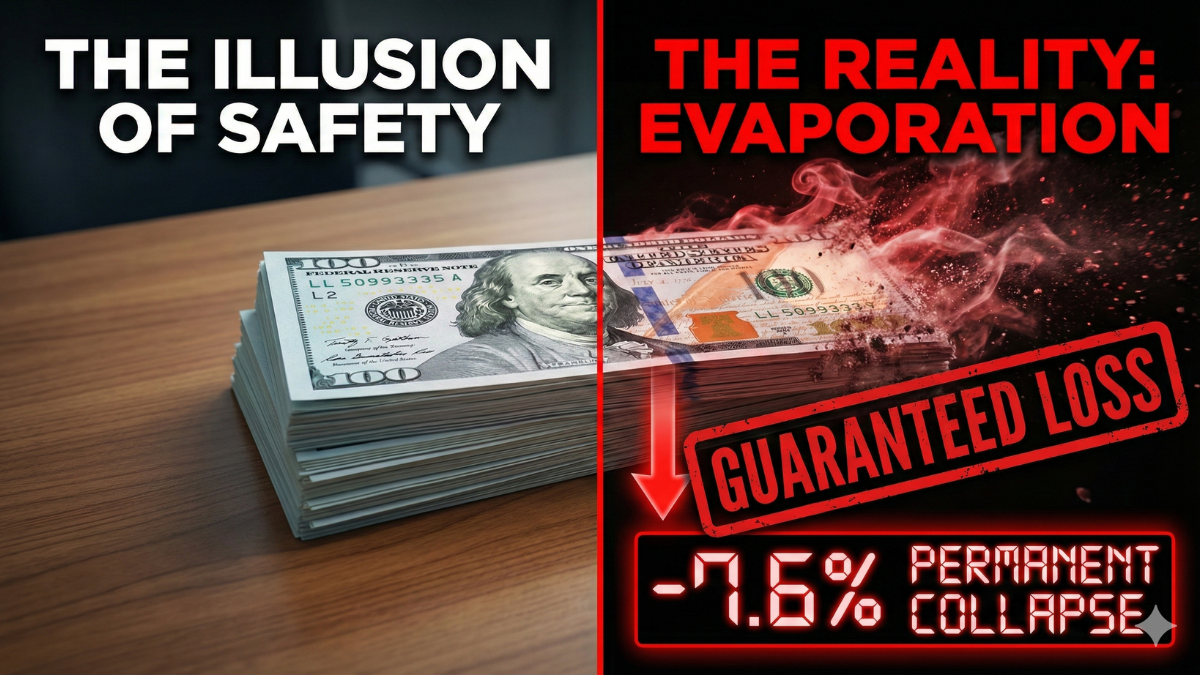
A new economic model released by the Hoover Institution paints a grim picture for American savers. Following the market turbulence of April 2025, researchers now predict a “steady-state depreciation” that could erode the U.S. Dollar’s real value by 7.6% annually.
The report suggests that the era of “safe” savings is over. With purchasing power dropping at this rate, standard bank accounts are failing to preserve wealth.
The ‘Mathematical’ Losing Bet
The core finding of the study is a shift in inflation mechanics. According to the data, holding cash in a traditional savings account is now a losing proposition. Even with nominal interest rates, the real return—what you earn after subtracting inflation—is deeply negative. “The math has changed,” the report notes. “Savers are effectively paying a 7.6% penalty every year for liquidity.”
Bond Market react with Volatility
The bond market is reacting nervously to this outlook. Long-term interest rates jumped by 0.25% (25 basis points) this week—a sharp move that signals investor caution. In the world of Treasury bonds, a move of this size in just a few days indicates that large institutions are demanding higher payouts to hold government debt, fearing that inflation will remain sticky.
The Legacy of the April Shock
Analysts point to the “April 2025 shock” as the turning point. Since that market correction, the dollar has struggled to regain its footing. Wealth strategists are now advising clients to look beyond savings accounts. To beat a 7.6% drag, investors are forced into hard assets like real estate, commodities, or equities, accepting higher risks to avoid the certainty of devaluation.
SOURCES
- Hoover Institution (Economic Working Paper Jan 2026)
- Federal Reserve Bank of St. Louis (Treasury Yield Data)
- The Wall Street Journal (Bond Market Commentary)