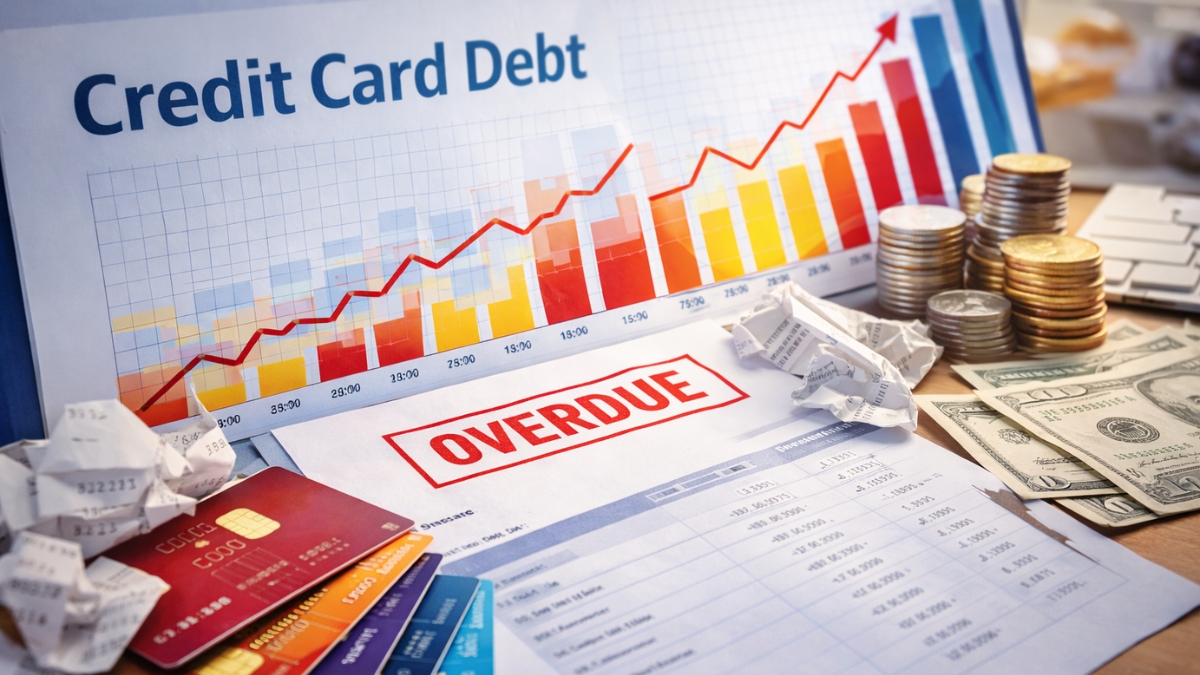
According to the Federal Reserve Bank of New York, total U.S. household debt rose to $18.8 trillion at the end of 2025, while credit card balances reached $1.28 trillion and transitions into serious delinquency on card balances ticked up. For many borrowers, that backdrop helps explain why progress on revolving debt can feel painfully slow in 2026. Minimum payments are designed to keep accounts current, but they often do not reduce principal fast enough when interest charges stay high and fees pile up. The result is a familiar but worsening trap: people keep paying, yet balances barely move.
Quick takeaways
- Credit card debt is sitting on top of a broader household debt pile that reached $18.8 trillion at the end of 2025.
- Card APRs remain high by historical standards, which means a larger share of each payment goes to interest before principal starts falling.
- Many issuers calculate the minimum as a small percentage of the balance plus interest, fees, and any past-due amount.
- CFPB data show more accounts are making only the minimum payment than in the Bureau’s last report.
- Paying the minimum can keep an account from going delinquent, but it is often a poor strategy for eliminating debt quickly.
What changed in 2026
The feeling that balances are “impossible to kill” did not appear out of nowhere. It comes after two difficult years for revolving debt. The New York Fed’s latest household debt data show total household debt at $18.8 trillion at the end of 2025. Within that total, credit card balances climbed to $1.28 trillion.
That matters because revolving debt behaves differently from installment debt. A fixed auto loan has a clear payoff path if payments stay on schedule. A credit card balance is more elastic. It can shrink, but it can also refill, and the financing cost can keep changing.
In 2026, the math is still tough. The Federal Reserve’s latest G.19 release shows the average APR on all credit card accounts at reporting banks was 20.97% in the fourth quarter of 2025. For accounts assessed interest, the average was even higher at 22.30%. When borrowing costs stay in that range, the minimum payment often acts more like a survival tool than a payoff plan.
Why the minimum payment often disappoints
Minimum payments are not random. The CFPB’s 2025 consumer credit card market report says most major issuers set minimum payments at about 1% of the balance, then add finance charges, fees, and past-due amounts on top. That structure keeps the account active and reduces immediate default risk for the issuer. It does not necessarily produce fast debt reduction for the borrower.
That distinction matters. If a borrower pays just enough to satisfy the minimum, a meaningful share of the payment can be absorbed by interest first. Add a late fee or a returned-payment fee, and the principal can fall only slightly, or in some billing cycles barely at all.
The CFPB also found that more consumers are making only the minimum payment. About 15% of general-purpose card accounts and 20% of private-label card accounts paid only the minimum each month in 2024. Roughly one-third of cardholders with subprime or near-prime scores made only the minimum on both general-purpose and private-label cards.
That is one reason balances feel sticky. The borrower may be making every required payment and still not getting the emotional reward of seeing debt fall quickly. A person can be current and still feel trapped.
Why delinquencies make the problem worse
The minimum-payment trap becomes more dangerous once a household starts slipping. The New York Fed said aggregate delinquency worsened in the fourth quarter of 2025, with 4.8% of outstanding debt in some stage of delinquency. It also said transitions into serious delinquency ticked up for credit card balances.
That trend does not mean every borrower is headed for trouble. It does show that more households are under strain. When income is squeezed by rent, insurance, groceries, or student loan payments, the minimum payment can start as a temporary bridge and then harden into a long-term habit.
Late fees can deepen the hole. The CFPB has said late fees disproportionately burden financially vulnerable consumers and that, even during the pandemic period, late fees still made up more than one-tenth of the roughly $120 billion consumers paid annually in credit card interest and fees. For households already close to the edge, one missed due date can change the payoff timeline fast.
What this means in the U.S.
For U.S. readers, the key point is practical rather than dramatic: minimum payments are built to prevent immediate default, not to eliminate expensive debt fast. In a high-APR environment, that difference becomes more visible every month.
This is also why many borrowers say they are doing “everything right” and still not making progress. They are paying what the statement requires. But the required amount may be too small relative to the interest being added. The payment keeps the account alive while the balance remains stubborn.
Private-label retail cards can be especially difficult for some households because CFPB data show minimum-only payment behavior is more common there. Promotional offers can also create confusion. CFPB consumer guidance warns that in deferred-interest deals, minimum payments may not be enough to clear the balance before retroactive interest risk becomes a problem.
What to watch next
The first issue to watch is rates. If card APRs stay near current levels, the payoff math remains harsh. Even modest additional borrowing can extend the life of an existing balance.
The second issue is distress. If card delinquencies continue to rise, issuers may tighten credit, lower limits for some borrowers, or become less flexible with account terms. That would not affect every household the same way, but it could make balance management more fragile for people already carrying debt month to month.
The third issue is payment behavior. If more consumers shift from paying in full to revolving balances, the minimum-payment trap becomes less of a niche problem and more of a mainstream household-money story.
What you can do
The CFPB’s guidance is straightforward. If the minimum itself is becoming hard to make, contact the card issuer immediately, explain the situation clearly, and ask for a temporary payment arrangement. The agency also points struggling borrowers toward reputable credit counseling and warns against debt relief firms that promise they can make debt disappear or tell consumers to stop communicating with card issuers.
For borrowers who are still current, the important takeaway is simple: the minimum is a floor, not a strategy. That does not make it useless. It can buy time. But in 2026, with card APRs still elevated and delinquency pressure building, paying only the minimum is one of the clearest ways a balance can stay alive far longer than expected.
SOURCES
- Federal Reserve Bank of New York — “Household Debt and Credit Report”
- Federal Reserve Board — “Consumer Credit – G.19”
- Consumer Financial Protection Bureau — “The Consumer Credit Card Market Report to Congress”
- Consumer Financial Protection Bureau — “What should I do if I can’t pay my credit card bills?”
- Consumer Financial Protection Bureau — “Credit card late fees”
DISCLAIMER
General information only; not financial advice.