
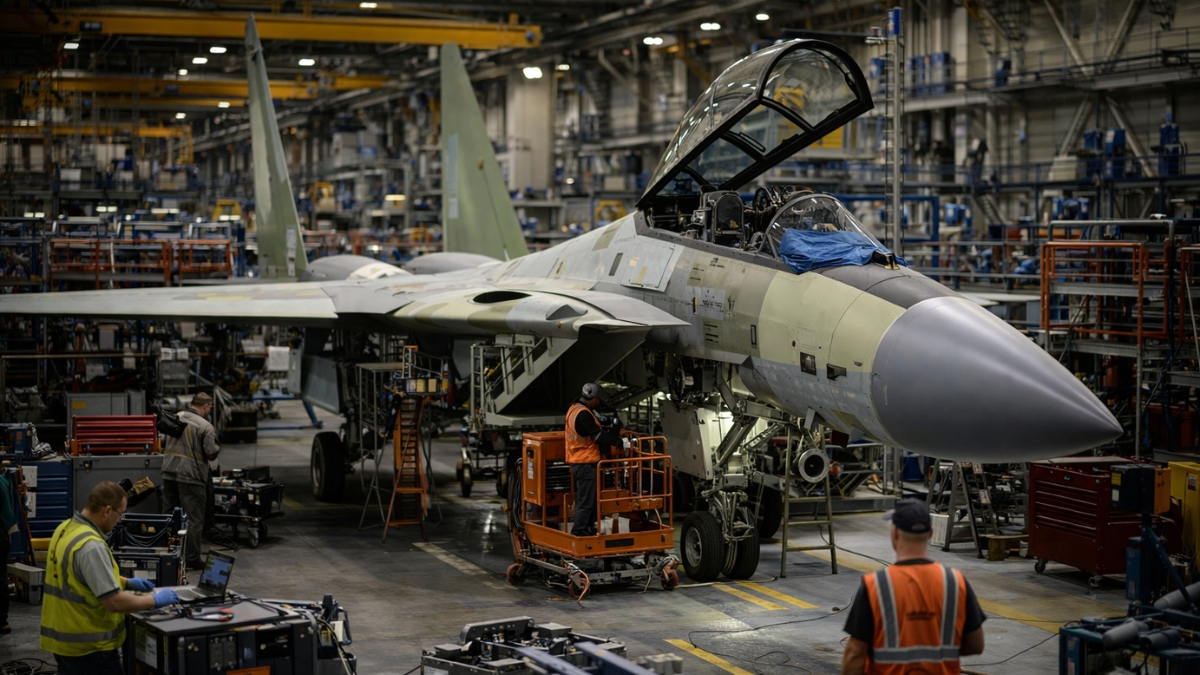
According to Yahoo Finance, Boeing shares were down 5.1% even after the company landed roughly $2.8 billion in new U.S. defense-related contract awards, a move that looked counterintuitive at first glance. On paper, fresh Pentagon work should have supported sentiment around a company still trying to stabilize operations and rebuild investor trust. But the market often reacts to more than the headline value of a contract award. For Boeing, that means traders are still weighing execution risk, cash-flow pressure, and production quality concerns more heavily than one day’s contract news.
Why Boeing’s Big Defense Win Still Failed to Impress Investors
For investors who only saw the top line, the sell-off looked strange. A multibillion-dollar batch of defense work would normally read as a positive signal for a major aerospace and military contractor. Boeing, after all, has spent years trying to convince the market that its turnaround story is becoming more credible.
The problem is that not all revenue is treated equally by Wall Street.
A contract headline can grab attention, but investors usually ask three harder questions right away: how profitable is the work, how much execution risk comes with it, and whether the award actually changes the company’s near-term cash outlook. In Boeing’s case, those questions remain uncomfortable.
Quick takeaways
- Boeing’s shares fell even as new defense awards boosted the order narrative.
- Investors appear more focused on execution and margin risk than raw contract size.
- Boeing’s defense business has a history of costly fixed-price programs and charges.
- Ongoing issues in commercial aircraft production still matter to the stock.
- The market may need evidence of cleaner delivery and cash generation before rewarding contract news.
Why the market did not celebrate the headline
The Pentagon’s recent contract notices included a massive option exercise tied to Boeing’s E-7A rapid prototype airborne mission segment, plus other smaller awards. That gives Boeing another proof point that it remains deeply embedded in U.S. defense procurement.
Yet investors have learned the hard way that backlog and shareholder value are not the same thing. Boeing’s defense unit has struggled in recent years with fixed-price development programs, overruns, and charges that turned what looked like strategic wins into financial drags. That history changes how the market reads new awards.
A large award can still be good news. It can protect industrial capacity, support future revenue visibility, and reinforce customer relationships. But it does not automatically solve margin concerns. If investors suspect a contract could be complex, politically sensitive, or expensive to execute, the stock can still fall on the day the award is announced.
Boeing is still trading under an execution discount
That broader skepticism matters because Boeing is not being judged in a vacuum. The company is still working through the legacy of multiple crises across both its commercial and defense operations.
On the commercial side, recent reporting showed Boeing repairing some undelivered 737 MAX jets because of wiring damage, a reminder that even seemingly manageable production issues can quickly revive investor anxiety. Markets tend to punish aerospace manufacturers when new quality concerns appear, even if management insists the problem is limited and fixable.
On the defense side, the company is also dealing with scrutiny around the KC-46 tanker program. Reuters recently reported that a top U.S. Air Force general said Boeing must resolve tanker problems before the service orders more aircraft. That kind of comment matters because it reinforces a long-running investor concern: Boeing still has major programs where operational reliability and customer confidence remain live issues.
Put simply, the stock is trading under an execution discount. Investors want proof that Boeing can deliver aircraft on time, control costs, and avoid fresh surprises. Until that happens consistently, positive headlines may produce only short-lived support.
What changed, and what did not
What changed is straightforward: Boeing added fresh defense work to its book, including a contract modification worth more than $2.3 billion on the E-7A program and other smaller defense-related awards around the same period. That strengthens the company’s long-term workload and helps support its role in major U.S. military programs.
What did not change is just as important. The company’s most urgent credibility test remains operational. Investors still want cleaner production, fewer quality disruptions, and better evidence that Boeing can turn revenue into dependable cash flow. One contract announcement, even a large one, does not erase those questions.
This is why the stock reaction can look disconnected from the news cycle. Financial markets are forward-looking, but they are also comparative. Traders weigh new contract wins against the full stack of risks already surrounding the company. Right now, that stack is still heavy.
Why it matters for readers beyond Boeing
This story is not just about one stock move. It is a useful reminder that markets often care more about quality of earnings than quantity of awards.
For large industrial and defense companies, investors are rarely impressed by headline contract values alone. They want to know whether the work is accretive, when cash will actually arrive, and whether management can execute without adding new losses. That is especially true when a company has a recent track record of program trouble.
In other words, a big contract can be strategically important and still fail to lift a stock. The market may agree that the work matters while also deciding that the risks are still too high.
What to watch next
The next phase of the Boeing story is likely to hinge less on contract announcements and more on operating evidence.
Investors will be watching delivery trends, updates on the 737 MAX repair issue, commentary from regulators and airline customers, and any sign that Boeing’s defense execution is improving. They will also watch whether management can show that recent awards are translating into healthier backlog quality rather than just bigger headline numbers.
For the stock to react more positively to future contract wins, Boeing probably needs something more valuable than one day of news flow: a sustained run of fewer setbacks.
What this means in the US
For U.S. readers, the takeaway is practical. Boeing remains central to both commercial aviation and national defense, so its problems do not stay isolated inside one ticker symbol. Delays, quality issues, and contract execution problems can ripple into airline capacity, Pentagon planning, supplier orders, and local employment across aerospace-heavy states.
That is why Boeing’s stock moves continue to attract outsized attention. They are not just a market story. They are also a confidence signal about one of America’s most important manufacturers.
SOURCES
- Yahoo Finance — “Boeing (BA) Is Down 5.1% After Landing US$2.8 Billion In New U.S. Defense Contracts”
- U.S. Department of Defense — “Contracts for March 12, 2026”
- Reuters — “USAF general says Boeing has to fix tanker problems before US orders more”
- Reuters — “Boeing repairing 25 737 MAX jets with wiring damage, Bloomberg News reports”
- Reuters — “Boeing posts bigger loss as defense business struggles to turn around”
DISCLAIMER
General information only; not financial advice.