
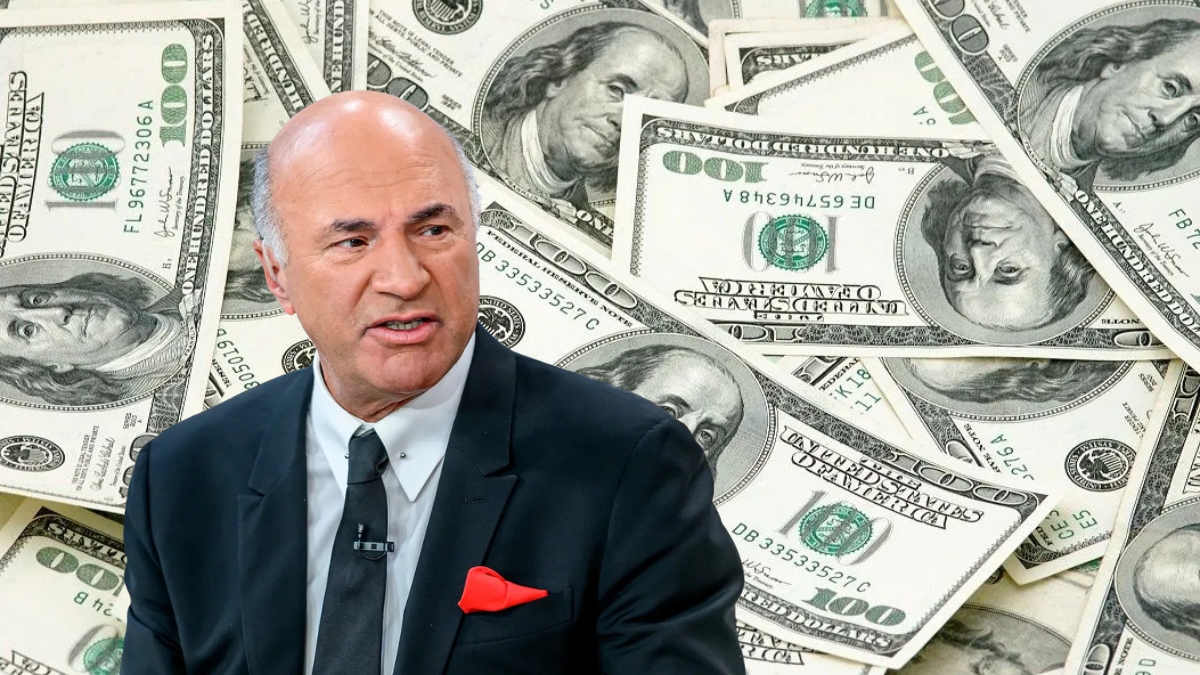
Kevin O’Leary has argued that retirement on $500,000 can work if the portfolio earns about 5% a year and the retiree lives on the income without touching principal. A personal-finance analysis published this week said the math is simple—$25,000 a year—but the 2026 question is whether “safe” yields can reliably reach that level. With Treasury yields below 5% and dividend yields often lower, the gap forces a trade-off between lower income and higher risk.
The yield gap: “safe” income often lands below 5%
The Federal Reserve’s 10-year Treasury series showed the yield around 4.18% in recent February readings. On $500,000, a 4.18% yield implies roughly $20,900 a year before taxes—below the $25,000 target.
Dividend-focused ETFs can offer higher income than broad-market index funds, but “high dividend” does not automatically mean 5% in 2026. For example, Vanguard’s High Dividend Yield ETF listed a 30-day SEC yield of 2.34% as of Jan. 31, 2026. A 2.34% yield on $500,000 is about $11,700 a year—less than half of the $25,000 target.
Some dividend ETFs show higher trailing yields, but those can move with prices and distributions. A widely followed dividend ETF such as Schwab’s SCHD was shown near the mid-3% range in recent third-party fund data. At a 3.5% yield, $500,000 produces about $17,500 a year—still short.
Bridge: If income is fixed at $25,000, inflation becomes the next pressure point.
Inflation: a fixed income stream buys less over time
The Bureau of Labor Statistics reported that CPI rose 0.2% in January and 2.4% over the prior 12 months. A retirement plan built on a flat $25,000 a year has no built-in income growth unless yields rise or principal is used.
At 2.4% inflation, maintaining the same purchasing power for 20 years would require roughly $40,000 a year (rule-of-thumb math, not a forecast). That is the quiet weakness of a strict “income-only” plan: it can preserve principal while slowly shrinking lifestyle flexibility.
Bridge: The strategy can still work for some households—but usually under narrower conditions than the slogan implies.
When the rule can work, and what it demands
A $500,000 portfolio can support retirement spending if total required income is low and other sources cover the gaps. That often means a paid-off home, limited debt, and Social Security covering a meaningful share of expenses.
The challenge is that getting to 5% with low volatility is not guaranteed. Moving up the yield ladder can mean more equity exposure, more credit risk, or a mix of both. Once market risk rises, the promise of a stable income stream can weaken in down years, especially if dividends are cut or prices fall.
This is market analysis, not a recommendation.
Scenario math: what $500,000 produces at common yield levels
These examples illustrate the scale of the gap. They assume a steady yield and ignore taxes and fees.
- 2.34% yield: about $11,700/year
- 3.50% yield: about $17,500/year
- 4.18% yield: about $20,900/year
- 5.00% yield: $25,000/year (O’Leary’s rule-of-thumb target)
Key numbers
- $500,000: portfolio size referenced in the rule
- 5%: implied annual return target for $25,000 income
- $25,000: annual income implied by 5% of $500,000
- 4.18%: recent 10-year Treasury yield reading (Fed series)
- 2.34%: 30-day SEC yield shown for a major dividend ETF (as of Jan. 31, 2026)
- 2.4%: January CPI year-over-year inflation rate (BLS)
Bottom line: the math behind “retire on $500,000” is real, but the 2026 environment makes the 5% assumption harder to meet using low-risk income sources. For many households, the rule becomes a choice between living on less than $25,000, accepting more market risk, or using a plan that allows some principal draw over time.
SOURCES
- https://247wallst.com/personal-finance/2026/02/13/kevin-oleary-says-you-can-retire-on-500000-but-only-if-you-follow-this-1-rule/
- https://fred.stlouisfed.org/series/DGS10
- https://www.bls.gov/news.release/pdf/cpi.pdf
- https://investor.vanguard.com/investment-products/etfs/profile/vym
- https://www.morningstar.com/etfs/arcx/schd/portfolio
FINANCE DISCLAIMER: This content is for informational purposes only. It reflects general market analysis and is not a recommendation to buy or sell any security or follow any specific retirement strategy. It is not tax, legal, or financial advice. Consult a qualified professional for guidance specific to your situation.